
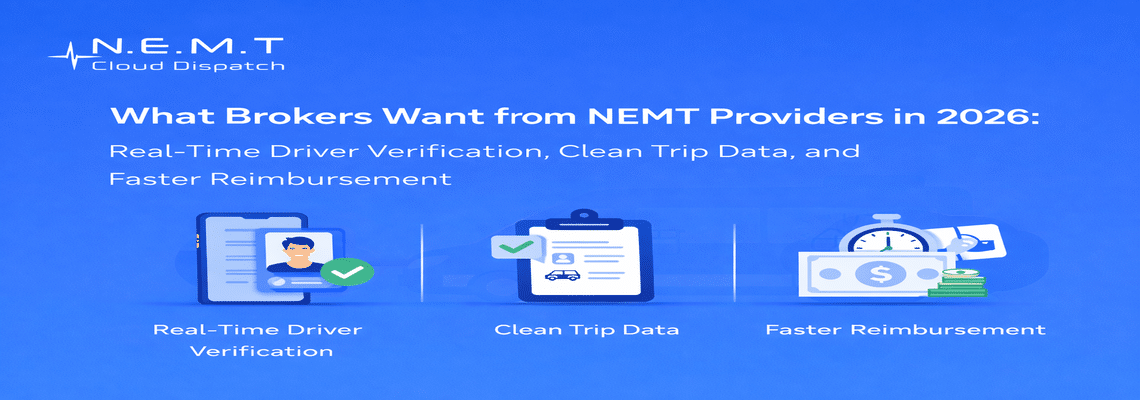
NEMT broker requirements are becoming stricter in 2026 as brokers demand real-time driver verification, clean trip data, and faster reimbursement from transportation providers. It is no longer enough to simply complete trips safely. Today’s broker networks expect providers to show that drivers are current, trip records are accurate, and billing data is clean enough to support fast, reliable payment. If your operation still depends on spreadsheets, manual updates, and disconnected driver files, you risk delays, disputes, and missed growth opportunities.
That is why understanding NEMT broker requirements matters more than ever. Current NEMTAC broker standards work highlights provider credentialing, complaint resolution, trip assignment, fraud prevention, timely reimbursement, interoperability, driver verification, and real-time data exchange as core expectations in broker-administered transportation networks.
At NEMT Cloud Dispatch, we help NEMT companies simplify dispatching, routing, fleet management, billing, broker support, driver workflows, and facility coordination in one cloud-based platform. This guide explains what brokers are looking for now, why those expectations are getting stricter, and how providers can meet them without overwhelming dispatch. You can explore our NEMT brokerages management software, NEMT driver app, and NEMT invoicing and billing software to see how these workflows connect.
Quick answer
The simplest way to understand NEMT broker requirements in 2026 is this: brokers want providers who can prove readiness in real time. That means current credentials, accurate driver status, complete trip records, faster issue resolution, and billing data that matches what actually happened on the road. Public broker-facing materials from Modivcare and MTM show the same pattern. They emphasize current documentation, licensure, background checks, insurance, inspections, and automated controls that can stop trip assignment when credentials are not current.
Why brokers are getting stricter
Broker oversight is becoming more operational and more data-driven. NEMTAC’s broker overview says the standard is designed to define quality-of-service benchmarks and digital technology expectations, including interoperability, driver verification, and real-time data exchange. That means brokers are no longer judging providers only by basic service delivery. They are judging them by how reliably their systems produce trustworthy information.
For providers, that changes everything. If your credentials are incomplete, your drivers cannot be verified quickly, or your trip records do not match your invoices, your business becomes harder to assign, harder to trust, and harder to pay. Strong NEMT broker requirements now touch compliance, operations, and cash flow at the same time.
NEMT provider credentialing is no longer a one-time task
Many providers still treat NEMT provider credentialing as an onboarding event. Brokers do not. They treat it as a living control system. Modivcare says it is moving toward automated transportation provider credentialing and ongoing compliance communication, while MTM states that its automated system will not allow trips to be assigned when required credentials are not current or sufficient.
That is why NEMT provider credentialing should include more than a folder of PDFs. Providers need a repeatable process for:
- tracking license expirations
- monitoring insurance and vehicle inspections
- maintaining background check status
- confirming contract-specific documentation
- reviewing exclusions and training records
- responding quickly when brokers request updates
Our NEMT HR management software and features page support teams that want better control over credentials, alerts, and user activity in one place. When your credential files stay current, dispatch does not have to scramble every time a broker asks for proof.
Real-time NEMT driver verification is becoming a core trust signal
Brokers want to know that the person assigned to the trip is the person actually performing it. That is where NEMT driver verification becomes essential. NEMTAC’s broker standards work explicitly names driver verification as part of its digital technology expectations for transparency and consistency across broker-administered networks.
In practical terms, NEMT driver verification supports several broker priorities:
- confirming active driver eligibility
- reducing fraud and assignment risk
- improving trip accountability
- strengthening complaint investigations
- matching trip execution to billing records
This is one reason our NEMT driver app matters. Dispatch teams need live trip visibility, not delayed phone calls and handwritten updates. When a driver’s activity is connected to dispatch in real time, broker-facing operations become cleaner, faster, and easier to defend.
Clean NEMT trip data is what separates organized providers from risky ones
Brokers do not just want rides completed. They want records they can trust. Clean NEMT trip data means the details of the trip are accurate, consistent, and usable across dispatch, reporting, and billing.
That includes:
- correct pickup and drop-off times
- accurate member and facility details
- status updates that reflect real field activity
- clear exception notes
- trip completion proof
- mileage and wait-time records when applicable
NEMTAC’s data exchange standards work exists because fragmented or inconsistent NEMT trip data creates confusion, delays, and disputes across the NEMT ecosystem. Standardized data exchange improves interoperability between brokers, providers, and technology vendors, which directly supports cleaner workflows and fewer manual corrections.
This is where NEMT dispatching software, NEMT scheduling software, and NEMT routing software create real value. Better trip data starts with better operational visibility.
Faster NEMT reimbursement depends on cleaner operations
Providers often think of NEMT reimbursement as a billing issue only. Brokers do not see it that way. They see reimbursement as the result of operational quality. If trip records are incomplete, credentials are missing, or documentation does not match the claim, payment slows down.
NEMTAC’s broker materials specifically identify timely reimbursement as a core broker responsibility, which means brokers are also paying more attention to whether providers submit accurate, supportable records.
For providers, faster NEMT reimbursement usually comes from four things:
- stronger trip documentation
- fewer manual corrections
- better reconciliation between dispatch and billing
- cleaner support for broker audits and denials
Our NEMT invoicing and billing software helps reduce rework by connecting invoices and claims to operational trip information. If your team works across multiple brokers, that connection becomes even more important.
Why NEMT broker integration matters more in 2026
In a broker-heavy market, disconnected systems create avoidable pain. NEMT broker integration helps providers move trip details, statuses, and billing-related data between systems with less delay and less manual entry.
NEMTAC’s broker and data exchange materials both stress interoperability and real-time data exchange as important parts of a more accountable NEMT environment. That makes NEMT broker integration more than a technical feature. It is an operating advantage.
With NEMT Cloud Dispatch, providers can align broker workflows with dispatch, routing, driver activity, fleet visibility, and billing. Our brokerages software, facility portal, and pricing page show how that operational stack fits together.
What brokers actually want from providers now
If you strip away the complexity, today’s NEMT broker requirements come down to reliability, visibility, and proof.
Brokers want providers who can:
- keep credentials current
- verify drivers in real time
- send accurate trip updates
- resolve issues fast
- reduce complaint risk
- submit billing backed by clean records
- scale without losing control
That is why NEMT broker requirements are now closely tied to your internal systems. Providers that rely on manual workarounds may still complete trips, but they create more uncertainty for brokers. Providers with better controls create confidence.
A practical checklist for providers
Use this checklist to assess whether your operation is ready for modern NEMT broker requirements:
Credentialing and readiness
- active provider contracts on file
- driver credentials reviewed on schedule
- insurance, inspections, and licenses current
- broker-specific documents easy to retrieve
Driver and trip execution
- live driver status visibility
- current assignment confirmation
- exception notes captured consistently
- no paper-only handoff between field and dispatch
Data and billing
- trip records match completed service
- invoices align with operational data
- denied claims reviewed by root cause
- payment delays tracked by broker or workflow gap
If those areas are weak, the right next step is not adding more manual effort. It is fixing the system behind the effort.
How NEMT Cloud Dispatch helps providers meet broker expectations
At NEMT Cloud Dispatch, we designed the platform around the real operational pressure points providers deal with every day. That includes dispatch speed, route clarity, trip status visibility, driver coordination, billing accuracy, and broker workflow support.
Providers use NEMT Cloud Dispatch to improve NEMT provider credentialing processes with better internal tracking, strengthen NEMT driver verification through connected driver workflows, maintain cleaner NEMT trip data through centralized dispatch and routing, support faster NEMT reimbursement with better billing alignment, and reduce friction through stronger NEMT broker integration across operations. Our platform is built to help providers meet modern NEMT broker requirements without burning out dispatch or losing revenue to preventable errors.
You can also read our related posts on NEMT compliance checklist for 2026 and NEMT contract performance in 2026 to strengthen your broader broker-readiness strategy.
Common mistakes that make brokers lose confidence
Even good providers create avoidable broker friction when they:
- let credential files lapse quietly
- rely on verbal updates instead of live status data
- submit claims that do not match trip records
- delay response to broker data requests
- manage multiple broker workflows in disconnected tools
Each of those mistakes makes NEMT broker requirements harder to meet consistently. Over time, they also slow growth because brokers prefer providers who are easier to manage, easier to trust, and easier to reimburse.
Final thoughts
In 2026, brokers want more than transportation capacity. They want providers who can operate with visibility, discipline, and proof. That is why NEMT broker requirements now center on real-time driver verification, clean trip data, and faster reimbursement. Providers that modernize those workflows will be easier to assign, easier to trust, and easier to pay.
If your team wants to simplify broker workflows, improve dispatch visibility, reduce billing friction, and stay ready for stricter network expectations, Request a Demo and see how NEMT Cloud Dispatch helps providers meet broker expectations with less manual work and better control.
Frequently Asked Questions (FAQs)
NEMT broker requirements increasingly focus on provider credentialing, driver verification, clean trip data, timely reimbursement, interoperability, complaint resolution, and operational transparency. NEMTAC’s broker standards work reflects that broader shift.
Because brokers need proof that providers and drivers remain eligible, safe, and compliant. Public broker-facing materials from Modivcare and MTM both emphasize active documentation, inspections, and automated controls around current credentials.
It improves accountability, reduces assignment risk, supports complaint review, and helps connect trip execution to the correct driver and trip record.
Brokers care most about accurate times, status history, member details, exception notes, trip completion proof, and any data that affects billing or service review.
They can improve reimbursement by reducing missing documentation, matching claims to trip records, keeping credentials current, and using better billing workflows.
It reduces manual entry, improves data consistency, and helps providers respond faster when brokers need accurate information.